I listened to my first episode of Stuff You Should Know sometime around 2009, it was the first podcast I had ever heard, and I have kept it in my rotation ever since. Last week they released an episode on the 1910 Flexner Report, which came to shape the field of medical education to this day. It was a part of history that I knew little of, and hearing the episode stirred up a lot of thoughts about medical training, the kind of doctor I try to be, and the kind of clinic I built at Sana Sana.
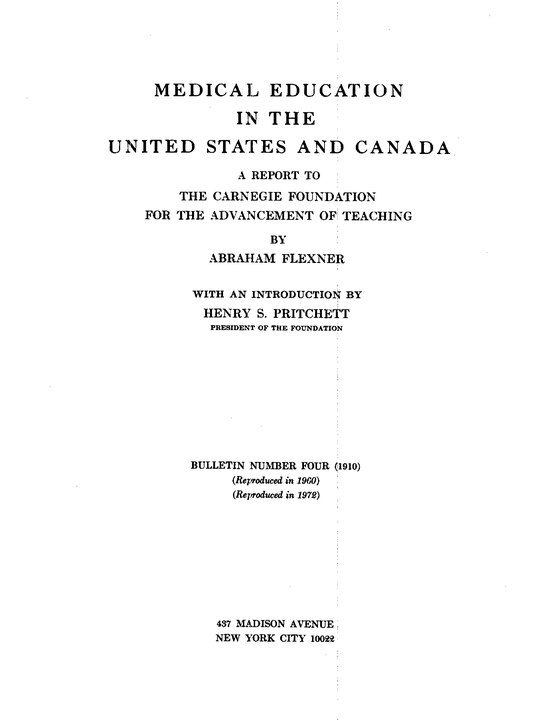
Before I go further: if you have 38 minutes, go listen to the episode. Josh and Chuck tell the story well, and did a great job as non-physicians in explaining the impact of this report for the improvements in medical education, right along with the harms the report failed to address or worsened. This post is not a recap of their episode. It’s my reflection, as a family physician, on what the Flexner Report set in motion, and what I think modern primary care needs next. For anyone who wants the primary source, the original 1910 report is publicly available. 
Why the Flexner Report happened at all
It’s hard to appreciate the impact of the Flexner Report without remembering the problem it was responding to. In the late 1800s and early 1900s, medical education in the United States varied wildly. Some schools were tied to universities and advancing science. Many others were underfunded, inconsistent, and in some cases essentially “pay tuition, get a credential” operations. If you were a patient, you had very little assurance that “doctor” meant any consistent level of training.
That inconsistency wasn’t just an academic issue. It was a public safety issue. A report like Flexner’s was, in many ways, an attempt to answer a simple question: What should a doctor actually have to learn, demonstrate, and practice before being allowed to care for people?
What Flexner got right
The Flexner Report pushed American medical training toward a more rigorous and scientific foundation. It emphasized standards for admissions, structured education, laboratory science, and closer ties between medical schools and serious academic institutions. The downstream effects of that shift are everywhere in modern medicine.
If you have ever benefitted from evidence-based diagnosis, safer surgery, reliable lab testing, effective antibiotics, cancer treatment protocols, or intensive care medicine, you’re benefitting from a medical culture that increasingly demands rigorous training and scientific grounding. Flexner-era reforms saved lives, and they helped medicine become more consistently effective. The report had flaws that reflect the era and the author, and the real harms caused by this very progressive document must be understood for addressing them.
The Tradeoffs, and What the Flexner Era Undervalued
The process of standardization can produce a certain kind of tunnel vision. Flexner had blind spots that are difficult to separate from the biases of his time. One of the biggest critiques, and indeed one of my greatest gripes with Flexner, is that the “scientific” identity of medicine sometimes got built at the expense of the “human” identity of medicine. In other words, the doctor became an expert in disease, but the system did not always protect or even remember the doctor’s role as a healer who knows the patient as a person.
If you have ever left a medical visit feeling like you were a checklist, or a diagnosis, or a “case,” you have experienced the dehumanization the turn of the century “purely scientific” approach can impose. Even when the science is well founded, and the best evidence is used in both diagnosis and treatment, patients can feel unseen when time is short and the system is moving too fast.
The Flexner legacy also intersects with equity, in ways that deserve honest acknowledgment. As an outcome of this report, many opportunities in medicine were narrowed rather than widened. Entire schools and pathways were shut down, and some of those closures disproportionately affected groups who were already being excluded from power and professional legitimacy
The harms caused by Flexner’s report do not negate the impactful progress it fueled. We needed better standards in medical education, but we also needed, and still need, a broader, more humane, more equitable vision of what health care should be.
Not Alternative, but Complementary
The SYSK episode also touches on how Flexner-era medicine drew hard lines around what “counts” as legitimate care. Some of those lines were necessary, and Flexner was writing at the height of medical quackery. But some of the hardlines around care considered “alternative” were overconfident, at times even dismissive and arrogant.
When I think about this today, I’m not interested in “alternative medicine” as a replacement for evidence-based care. As far as I am concerned, Flexner buried alternative medicine and given the very nature of the word I propose we leave it in the ground. What I am interested in is complementary approaches that can employ techniques and approaches sometimes called “alternative” not in lieu of but as a support to our very modern medicine. We add tools that are evidence-informed, safe, and patient-centered. It does not mean we substitute “alternatives” for proven treatments when proven treatments are needed.
This can include things like sleep, movement, nutrition, stress management, meditative practices, and for some conditions, acupuncture, which I was trained in. The kinds of techniques Flexner’s crowd might have scoffed at. Used thoughtfully, these complementary approaches can support healing, symptom control, and resilience, and they should live alongside modern medical science, not in opposition.
Seeking Balance Between Science and Soul at Boston University
One of the reasons I feel proud of the tradition I came from at Boston University School of Medicine is the school’s long history of breaking down the barriers to medical education and access to healthcare, which were present from the school’s founding prior to the Flexner report and which survive to the present. My alma mater is an example of an institution that ascribed to the high standards that Flexner called for, while always striving to address medicine’s ever present access gap, both to education and the care itself.
My medical school’s history traces back to the New England Female Medical College, founded in 1848, the first institution in the United States to train women in medicine. I count among my fellow alumni Dr. Rebecca Lee Crumpler, class of 1864, who is widely recognized as the first Black woman physician in the United States, and Dr. Charles Alexander Eastman, class of 1890, who was one of the first native americans to receive an MD in the US. Their commitment to open doors may be part of the reason I was accepted at Boston University in 2012, one of my “dream schools,” when my “safety schools” in my home state of Florida said no.
When I was at BU (2012–2016), I received the rigorous medical education that modern American medicine inherited from Flexner-era reforms. Entrance was no easy task, having accepted about 0.5% of applicants in the year I got in. The scientific standards were rigorous, and the expectations were high. A modern Flexner would approve.
But beyond the almost cliche cold scientific white coat white wall modern medicine, I was taught with an intentional focus on humanism in medicine. I learned the skills of patient-centered interviewing, asking open-ended questions, and on utilizing my sympathetic compassion as a valuable clinical tool instead of a distracting emotion to be repressed. That part of my training resonated with me deeply, and it shaped and continues to mold the kind of physician I would become, and still want to be.
I have felt the friction when the system makes humanistic medicine harder to practice, and my clinical identity has always been pulled toward the human side of care. That value has been a through-line in my career. I was honored to be part of the Gold Humanism Honor Society and to receive humanitarian-focused recognition during training. Later in residency, my program created and awarded me their Humanitarian award, which is now called the Bryan W. Pardo, MD Humanitarian award. It is one of the most meaningful professional honors of my life, especially because it represents the thing I care most about in this work: showing up for people with competence and compassion at the same time.
From Dr. Flexner to Dr. Pardo
In learning about the Flexner report and looking into it for the first time, I could not help but to reflect how the history of this 1910 document so impacted my own.
One of the most frustrating experiences for many physicians is this: we are trained to be patient-centered, to listen, to ask open-ended questions, to practice compassion, and to build trust, and then we graduate into a system that often rewards speed, volume, and short visits.
I reflected on that mismatch from my very first blog post, which you can read here: My Next Chapter The gap between the doctor I was trained to be and the realities of modern medicine was one of the greatest drivers behind my decision to open Sana Sana Clinic as a Direct Primary Care (DPC) practice.
DPC does not call for rejecting modern medicine. It’s about protecting the conditions that allow modern medicine to actually feel human.
The Flexner Report helped standardize the science of medicine, I believe DPC helps protect the relationship. I hope we can appreciate and keep the best of Flexner’s legacy: rigor, standards, and a commitment to evidence. I also hope we continue to rebuild the humanism and equity in medical education and practice that is more present today than in Flexner’s era but still has miles to go yet.
If this topic interests you, I really suggest you go listen to the Stuff You Should Know episode: How the Flexner Report Changed Medicine. Even if you don’t usually do podcasts. It was my first in 2009 and Josh and Chuck are the best at what they do.
If you’re looking for a primary care experience that makes room for both science and humanity, that’s exactly what I’m building at Sana Sana Clinic. If you want to learn more about how Direct Primary Care works, or if you’re curious whether Sana Sana might be a good fit for you, I’d love to meet you! Click any of the my sign up links to ask about scheduling a meet and greet!